
Travel Planning · 10 min read
Useful Vietnamese Phrases for Your Da Nang Trip
The handful of Vietnamese phrases for travelers that make Da Nang easier and friendlier, from saying thank you to ordering coffee, haggling and asking for help.
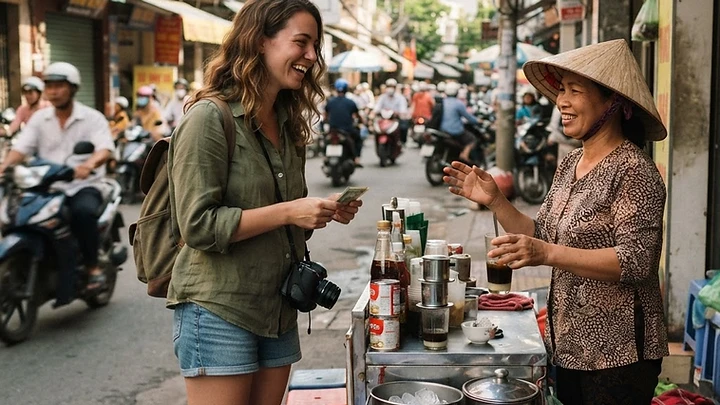
The most useful Vietnamese phrases for travelers in Da Nang are a small set you can learn on the flight: xin chào (hello), cảm ơn (thank you), bao nhiêu tiền? (how much?), không cay (not spicy) and tính tiền (the bill, please). With about 20 words, you can greet people, order food, pay, take a taxi and ask for help. Locals warmly appreciate even clumsy attempts, and a smile does the rest.
Why does this matter? English is common in hotels and tourist spots, but less so at street food stalls, local markets and small cafes, which is where many of Da Nang's best experiences happen. A few words of basic Vietnamese for tourists can mean better service, fewer misunderstandings and many more smiles.
Key Takeaways
- Learn five survival words first: xin chào, cảm ơn, xin lỗi, bao nhiêu tiền and không.
- Vietnamese has six tones, so the same letters can mean different things. Do not worry: context and a smile usually carry you.
- Da Nang has a central Vietnamese accent and a few local words that differ from Hanoi or Ho Chi Minh City.
- Calling staff "em ơi" (for younger people) or "anh ơi / chị ơi" (for older men and women) is normal and polite.
- Food phrases like không cay (not spicy), ít đường (less sugar) and không đá (no ice) are the most useful in daily life.
- Keep a translation app with a camera feature as backup for menus and signs.
Before You Start: Tones, Spelling and the Da Nang Accent
Vietnamese uses the Latin alphabet with extra marks, so you can read signs once you know a few rules. The marks above and below letters show the tone, and tones change meaning. "Ma," "má," "mà," "mả," "mã" and "mạ" are all different words.
That sounds scary, but here is the honest truth: as a visitor, nobody expects perfect tones. In a restaurant or taxi, people know what you are likely trying to say. Speak slowly, smile and point when needed.
A few pronunciation shortcuts
- "Đ" (with a bar) sounds like a normal English "d."
- "D" (no bar) sounds like a "y" in central and southern Vietnam, including Da Nang. So "dạ" sounds like "yah."
- "X" sounds like "s." Xin chào is "sin chow."
- "Ng" at the start of a word is like the "ng" in "singer." Ngon (delicious) is "ngon," said quickly.
- "Nh" sounds like the "ny" in "canyon."
The Da Nang accent
Da Nang sits in central Vietnam, and its accent is different from both Hanoi and Saigon. Locals may also use a few regional words you will not find in standard phrasebooks:
- mô = where (standard: đâu)
- tê = there, that (standard: kia)
- răng = why, how (standard: sao)
- rứa = like that, so (standard: vậy)
- ni = this (standard: này)
You do not need to use these words, but recognizing them is fun, and locals often laugh with delight when a visitor tries "răng rứa?" (why is that?).
Basic Vietnamese for Tourists: Greetings and Polite Words
These are the words you will use dozens of times a day. Pronunciation guides are approximate English sounds, not exact.
- Xin chào (sin chow) = Hello. Works any time of day.
- Chào anh / chào chị / chào em = Hello to an older man, an older woman, or a younger person. Friendlier than plain "xin chào."
- Tạm biệt (tam bee-et) = Goodbye.
- Hẹn gặp lại (hen gup lie) = See you again.
- Xin lỗi (sin loy) = Sorry, or excuse me.
- Dạ (yah) = A polite "yes" or "I hear you," very common in Da Nang.
- Có (gaw) = Yes, I have, or there is.
- Không (khome) = No, or not.
- Tôi không hiểu (toy khome hew) = I don't understand.
- Tôi tên là... (toy ten lah) = My name is...
- Bạn khỏe không? (ban kweh khome) = How are you?
How to address people
Vietnamese uses family-style words instead of "you." In daily life, the most useful are:
- Anh for a man a bit older than you, or about your age.
- Chị for a woman a bit older than you, or about your age.
- Em for someone clearly younger, such as a young waiter.
- Ơi added after these words is like saying "hey" politely. "Em ơi!" is how you call a server over.
If you are unsure, using anh or chị is the safer and more respectful choice.
How to Say Thank You in Vietnamese
This is the phrase people search for most, so here are all the useful versions.
- Cảm ơn (gahm uhn) = Thank you. You will also see it spelled "cám ơn," which is common in the south and central regions.
- Cảm ơn nhiều (gahm uhn nyew) = Thank you very much.
- Cảm ơn anh / chị / em = Thank you, with the right "you" word. This sounds warmer and more natural.
- Xin cảm ơn = A more formal thank you, often used in speeches or signs.
How to reply when someone thanks you:
- Không có gì (khome gaw zee) = You're welcome, it's nothing.
- Không có chi (khome gaw chee) = The same, more common in central and southern Vietnam. You will hear this often in Da Nang.
A small tip: a slight nod or smile with your thank you goes a long way. Overly formal bowing is not expected.
Shopping and Prices: Numbers and Haggling Phrases
Knowing a few numbers and price phrases helps at markets and also protects you from honest mistakes. Our guide to common Da Nang scams explains why counting zeros matters so much with Vietnamese dong.
Price phrases
- Bao nhiêu tiền? (bow nyew tee-en) = How much is it?
- Cái này bao nhiêu? (guy nay bow nyew) = How much is this one?
- Đắt quá (dut kwah) = Too expensive.
- Bớt đi (bert dee) = Lower the price, please. Say it with a smile.
- Được không? (duh-uck khome) = Is that okay? Can you?
- Tôi lấy cái này (toy lay guy nay) = I'll take this one.
- Tôi chỉ xem thôi (toy chee sem toy) = I'm just looking.
Numbers 1 to 10
- một (mote)
- hai (hi)
- ba (bah)
- bốn (bone)
- năm (nahm)
- sáu (sow)
- bảy (bye)
- tám (tahm)
- chín (chin)
- mười (muoy)
Bigger numbers: trăm = hundred, nghìn or ngàn = thousand, triệu = million. In central and southern Vietnam, people often say ngàn. Prices are often shortened in writing with a "k," so "50k" means 50,000 dong. At markets you may also hear chục used for tens of thousands, for example "hai chục" for 20,000. If you are unsure, ask the seller to type the number on a phone or calculator.
Haggling is normal at markets and with street vendors, but not in supermarkets, malls or restaurants with printed menus. Keep it friendly. A few thousand dong matters much less to you than to many sellers.
Ordering Food and Coffee Like a Local
Food is where Vietnamese phrases for travelers pay off fastest. Many street stalls in Da Nang have short menus or none at all, so a few words open up a lot.
Ordering
- Cho tôi... (chaw toy) = Can I have... (literally "give me"). Add the dish name.
- Một cái này (mote guy nay) = One of this. Point at a picture or a neighbor's plate.
- Hai phần (hi fun) = Two portions.
- Ngon quá! (ngon kwah) = Delicious! Cooks love hearing this.
- Tính tiền (ting tee-en) = The bill, please. Or call "Em ơi, tính tiền!"
Customizing your food
- Không cay (khome kai) = Not spicy.
- Ít cay (eet kai) = A little spicy.
- Tôi ăn chay (toy un chai) = I'm vegetarian.
- Không thịt (khome tit) = No meat.
- Không rau mùi (khome zow mooy) = No cilantro.
- Không bột ngọt (khome bote ngot) = No MSG.
If you have a food allergy, write it down in Vietnamese on a card or save it on your phone, and show it every time. Speaking alone is not reliable enough for allergies. Our staying healthy in Da Nang guide has more food safety tips.
Drinks and coffee
- Cà phê sữa đá (gah feh suh-a dah) = Iced coffee with condensed milk.
- Cà phê đen (gah feh den) = Black coffee.
- Không đá (khome dah) = No ice.
- Ít đường (eet duong) = Less sugar.
- Không đường (khome duong) = No sugar.
- Nước lọc (nuoc lawp) = Filtered water.
- Bia (bee-ah) = Beer.
- Một, hai, ba, dô! (mote, hi, bah, yo) = One, two, three, cheers! The classic Vietnamese toast.
Coffee in Da Nang deserves its own guide, and we wrote one: our Vietnamese coffee guide explains the main styles and how to order each one.
Getting Around: Taxis, Directions and Hotels
Most travelers use ride-hailing apps where the destination is typed in, which removes most language problems. Still, these phrases help with drivers, hotel staff and street directions.
- Cho tôi đến... (chaw toy den) = Take me to... Add the place name, or show it on your phone.
- Ở đâu? (uh dow) = Where is it? For example, "Nhà vệ sinh ở đâu?" (nyah veh sin uh dow) = Where is the toilet?
- Đi thẳng (dee tang) = Go straight.
- Quẹo trái (kweo try) = Turn left. Common in central and southern speech. You may also hear "rẽ trái."
- Quẹo phải (kweo fie) = Turn right.
- Dừng ở đây (zung uh day) = Stop here.
- Chậm thôi (chum toy) = Slow down, please.
- Bãi biển (by bee-en) = Beach.
- Chợ (chuh) = Market. Chợ Hàn is Han Market.
- Khách sạn (khak san) = Hotel.
A handy trick: save your hotel's name and address in Vietnamese on your phone, and take a photo of the hotel's business card. Showing it to any driver solves most problems instantly.
Emergency and Health Phrases
We hope you never need these, but they are worth saving on your phone.
- Giúp tôi với! (yoop toy vuh-ee) = Help me!
- Gọi cảnh sát (goy kang sat) = Call the police.
- Gọi xe cấp cứu (goy seh gup gew) = Call an ambulance.
- Bệnh viện ở đâu? (ben vee-en uh dow) = Where is the hospital?
- Nhà thuốc (nyah twook) = Pharmacy.
- Tôi bị lạc (toy bee lack) = I'm lost.
- Tôi bị ốm (toy bee ohm) = I'm sick.
In Vietnam, the emergency numbers are 113 for police, 114 for fire and 115 for an ambulance. Hotel staff can also help you call and explain. Our resources page lists medical and emergency services in Da Nang.
Tips to Learn Fast and Use Vietnamese Confidently
You do not need lessons to get the benefit. Here is a simple plan that works on a short trip.
- Learn five words on the flight. Xin chào, cảm ơn, xin lỗi, bao nhiêu tiền and không.
- Add one food phrase a day. Start with không cay or ít đường, depending on your taste.
- Listen to how locals say them. Your hotel receptionist or a cafe owner is usually happy to help you practice.
- Use your phone as backup, not first choice. Translation apps with a camera feature are great for menus and signs, but a spoken "cảm ơn" builds a better connection.
- Do not apologize for your accent. Just smile and try. People in Da Nang are generally patient and kind with visitors.
Common mistakes to avoid
- Raising your voice when not understood. Slowing down and pointing works better.
- Using "em" with older people. It can come across as rude. When in doubt, use anh or chị.
- Assuming a "yes" means agreement. "Dạ" often means "I hear you," not "I agree." Confirm prices clearly.
- Haggling in fixed-price places. Keep bargaining for markets and street vendors.
Five words and a smile will open more doors in Da Nang than a perfect accent ever could.
Put Your New Phrases to Work
The best way to practice is out in the city: a coffee stall in the morning, a market at noon, a seafood dinner by the beach. Every "cảm ơn" makes your trip a little warmer.
Browse the places in our directory to find cafes, markets and food spots where you can try your new words.
Quick answers
- What are the most useful Vietnamese phrases for travelers?
- The most useful are xin chào (hello), cảm ơn (thank you), xin lỗi (sorry), bao nhiêu tiền? (how much?) and không (no). Add không cay (not spicy) and tính tiền (the bill, please) for meals.
- How do you say thank you in Vietnamese?
- Say "cảm ơn," pronounced roughly "gahm uhn." For extra warmth, say "cảm ơn nhiều" (thank you very much) or add anh, chị or em to address the person.
- Do people in Da Nang speak English?
- Many people in hotels, tourist restaurants, tour companies and larger shops speak some English. At street stalls, local markets and small cafes, English can be limited, so basic Vietnamese and a translation app help.
- Is basic Vietnamese for tourists hard to learn?
- The tones make Vietnamese hard to master, but a few survival phrases are easy to learn in a day. Locals usually understand from context even if your tones are off.
- How do you call a waiter in Vietnam?
- Say "em ơi" to call a young server, or "anh ơi" or "chị ơi" for an older man or woman. It is the normal, polite way to get attention in Vietnamese restaurants and cafes.
- Is the Da Nang accent different from Hanoi?
- Yes, Da Nang has a central Vietnamese accent and some local words, such as "mô" for where and "răng" for why. Standard phrases still work perfectly, and locals understand them easily.
More on Travel Planning
All Travel Planning articles

Da Nang in November: Weather, Tips and What to Expect
November is Da Nang's wettest month, with heavy rain on up to 28 days and real flood risk. Here is everything you need to plan a smart, flexible trip.


Da Nang Mall Guide: Aeon, Lotte Mart, Vincom and More
Da Nang now has more mall options than ever, from the brand-new Aeon Mall to longtime favorites like Lotte Mart and Vincom Plaza. This guide tells you exactly what each one is best for and how to get there.


40 Best Things to Do in Da Nang: The Complete 2027 Guide
From sunrise swims at My Khe to fire-breathing dragons over the Han River, Da Nang packs an enormous range of experiences into one compact city. This guide covers the 40 best things to do in Da Nang, with prices, timings, and insider tips for every budget.